For writing a series
Chapterglass
For anyone writing a series. The map reveals itself chapter by chapter, and publishes as plain files you own.
A map of your series that stops at the chapter each reader is on, published as files on your own site.
Your map can finally keep a secret until chapter eleven.
Chapterglass has not launched yet. The sample book and its maps are original work by the studio, released under CC0.
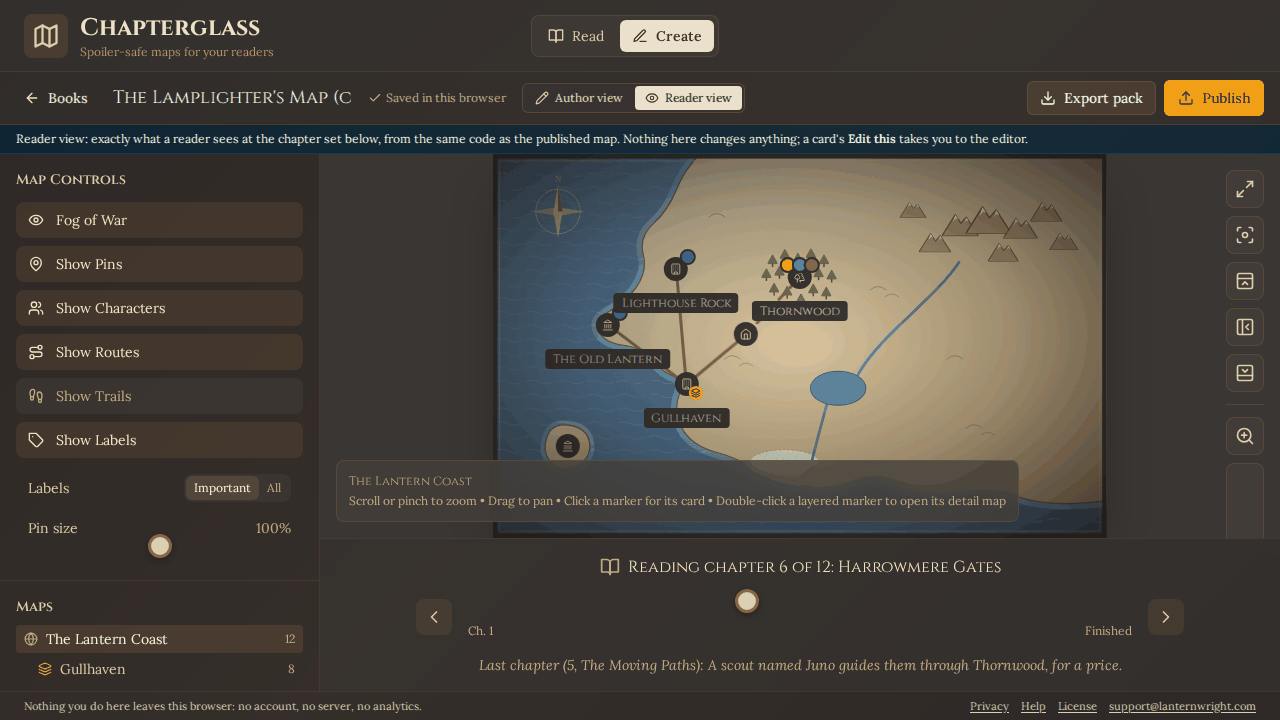
Chapterglass lets an author mark where every place, route and character appears in their series, and when a place gets its real name. Readers pick the chapter they have finished and see only what the story has told them: the map, the routes between places they know, where each character is, and a recap of the last chapter they read. The author publishes it as a small folder of plain files for their own site, or embeds it in a page. Everything happens in the browser. There is no account and no server, and Lanternwright never sees the book. Game masters use the same engine with sessions instead of chapters.
Maps you can open
- Treasure Island The narrator names the island in his first sentence, and the anchorage they moor in stays “???” for fourteen chapters.
- The Wonderful Wizard of Oz The country fills in at the pace Dorothy walks it, and the others move along the road with her.
- Dracula London opens into a map of its own, and the Count only moves on it once you have read that he moved.
Who it's for
For anyone writing a story long enough that readers lose track of it: indie fantasy, LitRPG and web-serial authors, and anyone else keeping a world and a cast straight across many chapters. Game masters use the same thing with sessions instead of chapters.
What it does
- It stops where the reader stopped. Places, routes, characters and the recap all follow the chapter the reader picks. A place can sit as "???" until the story names it, routes are drawn only between places they know, and the recap covers the chapter just finished, never the one being read.
- The published files are yours. Publishing builds a zip in your browser: a page, the map viewer, your map images. Put it on your own site, upload it as an HTML project, or open it from a folder. It contacts no server and keeps no analytics.
- Your patron chapters stay out of it. Choose the last chapter to include. Everything after it, including names readers have not learned yet, is left out of the published files entirely rather than hidden in them.
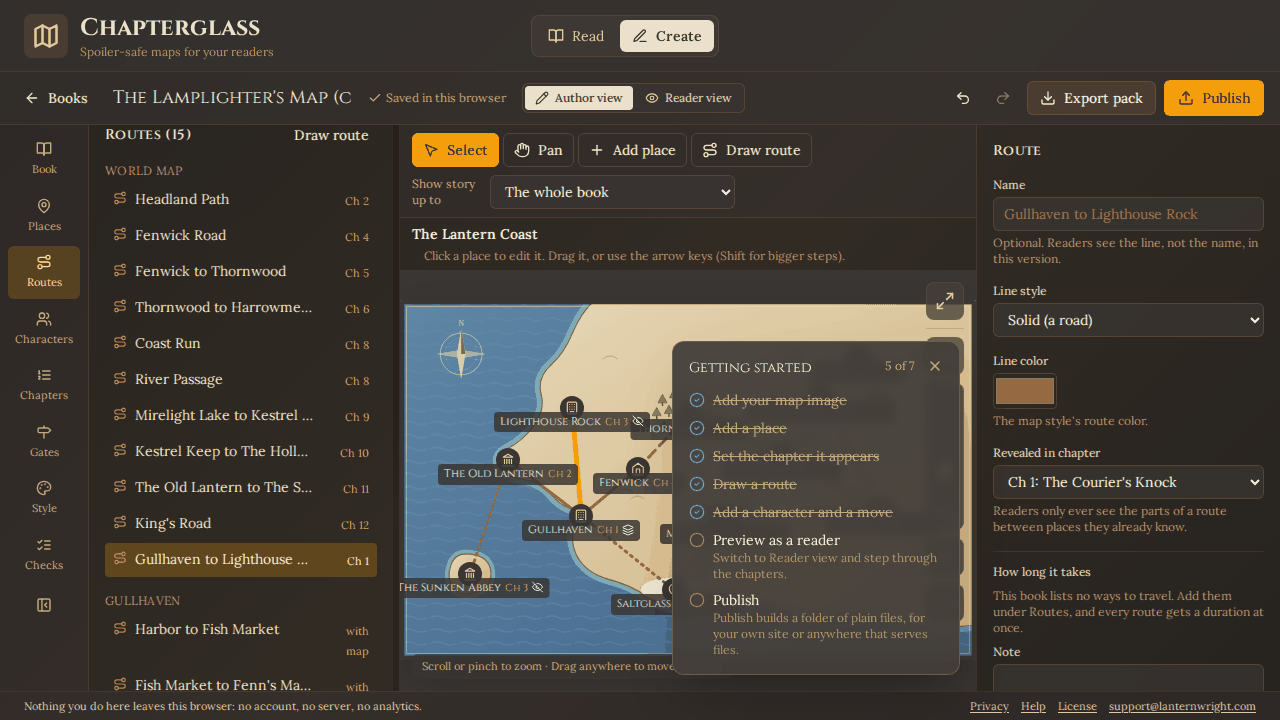
- You set it once. Say which chapter each thing appears in, and every reader at every chapter gets the right map afterward without you touching it again.
- Checks catch spoilers before readers do. Every recap, title, description and note is compared with what readers know at that chapter. A name used too early, a character standing somewhere readers cannot see, a route that would never show: each one opens the thing to fix.
- Nothing leaves your browser. Projects and map images live in your browser's own storage, and publishing builds the files on your computer.
- It runs a campaign map too. Game masters get sessions instead of chapters, a "Reveal now" for anything the party finds early, a player window for the second screen, and a player map capped at the last session played.
- Start from an original demo book. The Lamplighter's Map is a twelve-chapter story with an original coastline and harbor-town map, released under CC0 so it can be taken apart and reused. A four-session demo campaign shows the game master side.
What it doesn't do
- It doesn't draw the map. Bring one from a map maker.
- It isn't a wiki, and it doesn't host anything for you.
- Files published from it can be read early by anyone determined.
- The editor wants a desktop browser. Reading works on a phone.
- No account, so no sync between your computers.
A few more screenshots
 (larger view)
Questions
- Does my book or map get uploaded anywhere?
- No. Projects are kept in your browser's own storage, and publishing builds the files on your computer. Lanternwright receives nothing.
- Can readers find later chapters by looking at the page source?
- Not in anything published with a chapter cap: later chapters, events, names and characters are not in the files at all, and places readers only know as "???" are written that way in the file.
- What if my map image has place names printed on it?
- The image is published as it is, so readers see those names from chapter 1. Export an unlabeled version from your map maker if the names are spoilers.
- Where do I put the published map?
- Anywhere that serves plain files: your own site, an HTML project on a store that hosts them, a static host, or a folder on your computer. You can also embed it in a page.
- What if I switch computers?
- Your projects stay in the browser they were made in. Export a pack file and import it on the other machine. There is no sync, because there is no server.
- Does it work on a phone?
- Published maps do: drag to pan, pinch to zoom, tap a marker. The editor is built for a desktop browser.
- I run a tabletop game. Is this for me?
- Yes. Start a campaign instead of a book; the chapters become sessions, and you reveal the map as the party plays.
- Does the license need an account or a connection?
- No. The code from your purchase email is checked on your device and kept in that browser; nothing is sent anywhere. Enter it once in each browser you work in.
What it keeps, and where
Everything stays on your device. There is no account, no server, no analytics and no tracking, and the maps you publish contact no server either.
Runs on, and what it'll cost
- Runs on
- The editor runs in a current desktop browser (Chrome, Edge, Firefox or Safari). Published maps open in any current browser, on phones too, from a folder or any host.
- Cost
- Free to read, and free to build and publish a map with a small "Made with Chapterglass" credit. A one-time Author license adds the extras: publishing without the credit, series sites, your own look, a public and a patron version in one step, and the game master exports. No subscription and no account: the code is checked on your device, and the version you have keeps working.
- License
- A one-time Author license for one person, with a full refund inside 30 days. The published-map viewer and the Book Pack format are MIT, and the demo book is CC0, so a map you publish is yours to host and change.
Foundry Virtual Tabletop and Obsidian are trademarks of their owners. Chapterglass is not affiliated with or endorsed by them.