For people who self-hostworking name
Thingstead
Runs on your own machines. Open source at the core.
One searchable index of every coding-agent session, on every machine you own.
For anyone who's lost a good session to the 30-day cleanup.
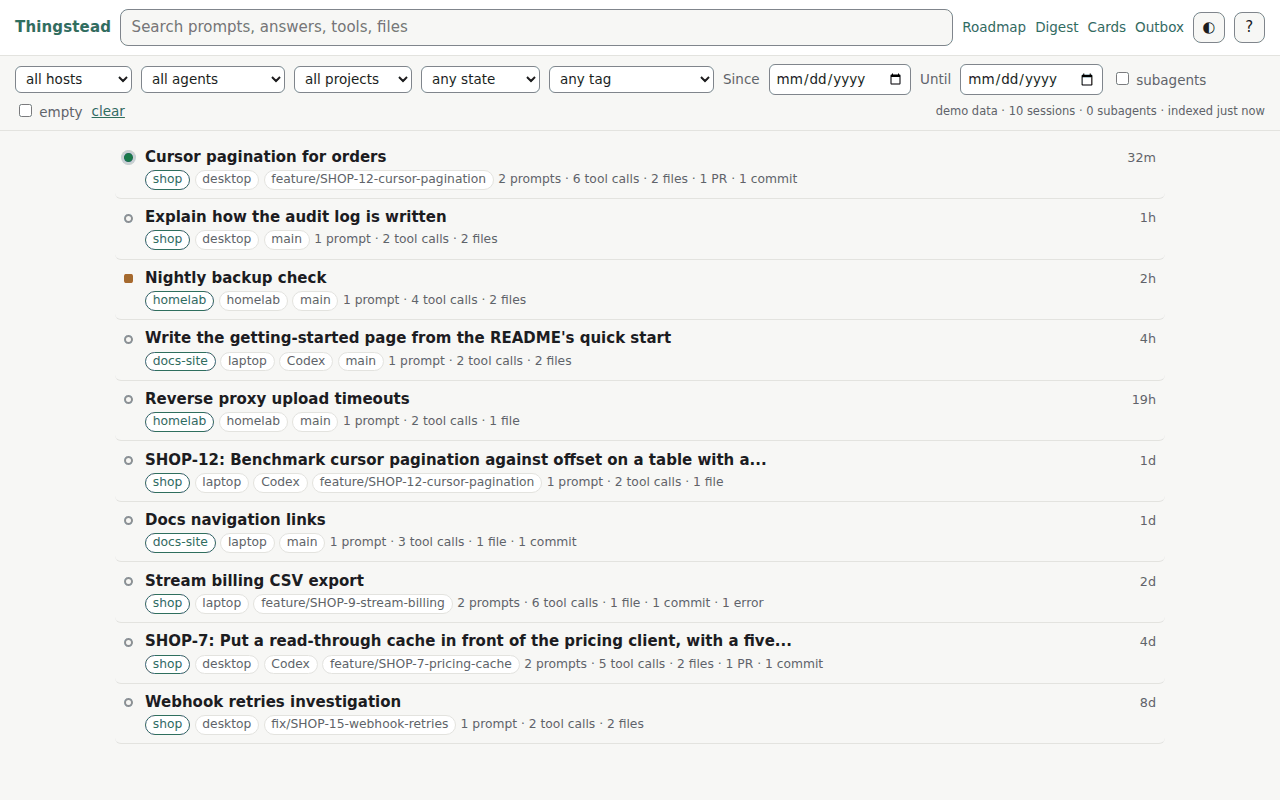 (larger view)
Thingstead indexes coding-agent sessions so every prompt, answer, file and commit is searchable across projects and machines. It links sessions to tracker cards, shows what's gone stale and what never got a card, and turns yesterday's work into a digest, without handing your transcripts to anyone. Today it reads Claude Code and Codex CLI sessions.
Who it's for
Developers who run many coding-agent sessions across more than one machine and want them searchable and tied to their tracker, on hardware they control.
What it does
- Search everything. Prompts, answers, tools, files, commits and pull requests, across every project, with snippets and filters.
- Keeps sessions past the 30-day cleanup. It warns when the agent's cleanup is about to delete old transcripts, and keeps a private archive copy on request. That part is free, and stays free.
- Readable titles. Plus tags for project, branch, tracker keys, languages and tools, and they survive a re-index.
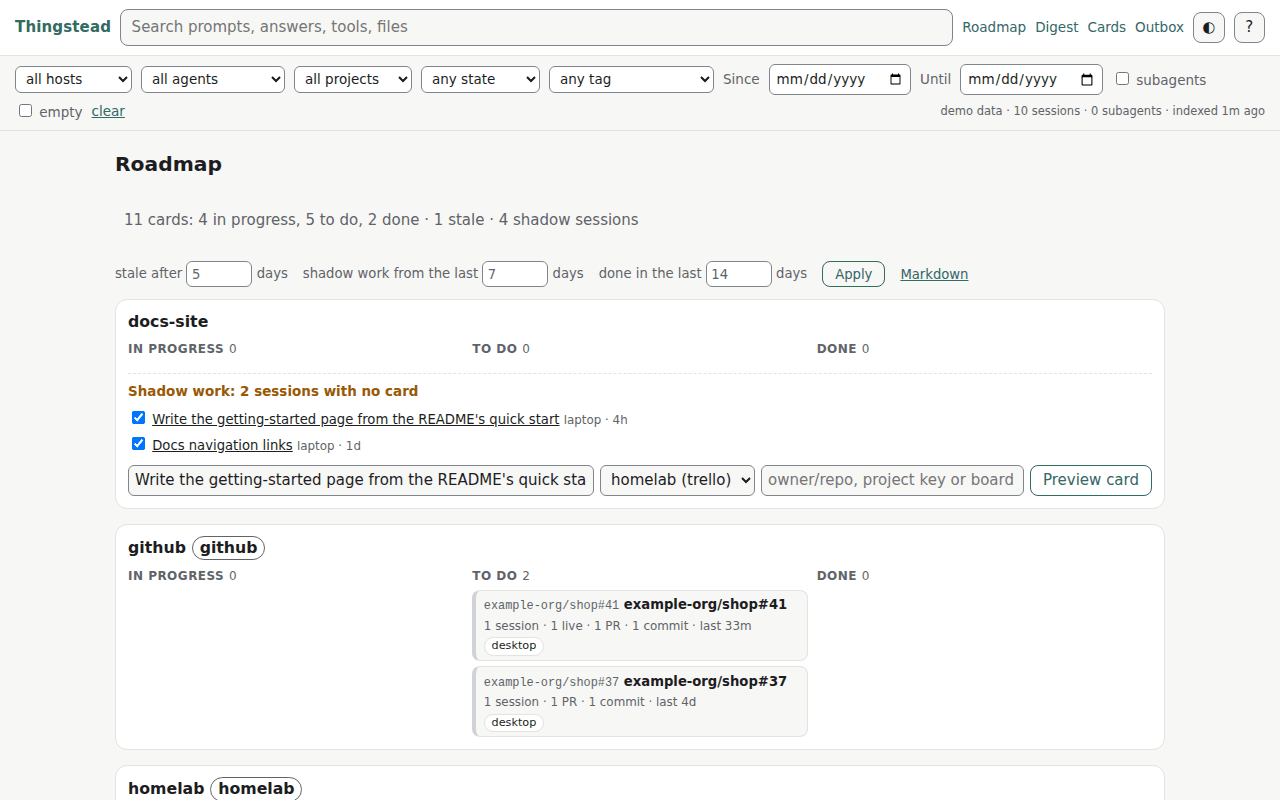
- Sessions linked to the tracker. Each card shows its sessions and each session shows its card. It suggests links with a reason and writes nothing until you've seen the exact payload. GitHub Issues is free; Jira and Trello need Pro.
- A roadmap (Pro). Lanes per project, what each card's sessions actually did, and flags for stale cards and work that never got a card.
- Yesterday, as a digest (Pro). Markdown, an Obsidian daily note, a Discord thread or an email.
- Every machine in one place (Pro). A small agent on each machine pushes redacted, signed metadata to a hub you run.
- Pick a session back up. Attach to its live pane, or start it on the right machine. It won't start a second copy of one that's already running.
- Obsidian export. One note per session, card and project, with frontmatter and wikilinks.
What it doesn't do
- Redaction is best-effort, so it can miss a secret.
- No native Windows version; it runs in WSL.
- Raw transcripts never leave the machine that wrote them.
- No hosted cloud. Syncing machines means running a hub.
- No telemetry, update check or license server.
A few more screenshots
 (larger view)
 (larger view)
What it keeps, and where
Thingstead runs on your machine, reads transcripts without changing them, and keeps its index in the home directory. It sends nothing anywhere until something that needs to is set up, and everything it sends passes one redaction gate first.
Goes online only for: Tracker linking (off until you turn it on); Daily digest (Pro) (off until you turn it on); Multi-machine hub (Pro) (off until you turn it on); Language model titles and summaries (Pro) (off until you turn it on).
Runs on, and what it'll cost
- Runs on
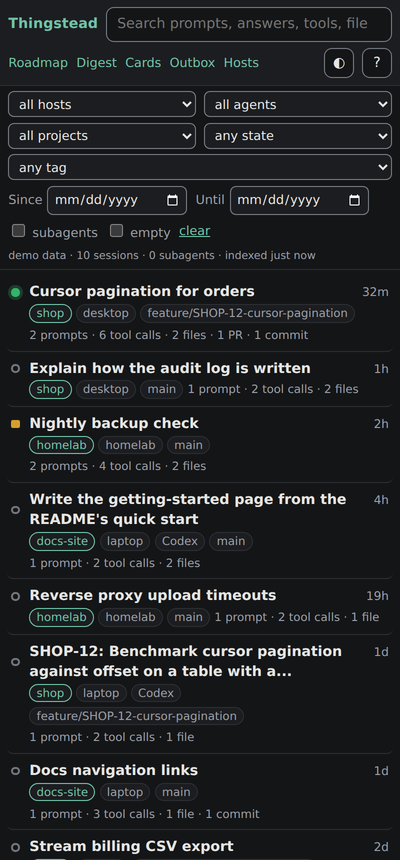
- Linux, WSL and macOS (Python 3.11 or newer, no other dependencies). Web UI in any browser, including at phone width.
- Cost
- The core is free and open source under the MIT license. Pro is planned as one purchase that adds more machines, more trackers, the roadmap and the digest, with a year of updates, and every version from that year stays unlocked.
- License
- MIT, so the code is open source.
Claude Code is a product of Anthropic. Codex CLI is a product of OpenAI. GitHub, Jira, Trello, Discord and Obsidian are trademarks of their respective owners. Thingstead is not affiliated with or endorsed by any of them.